Sunday, 12 April 2015

Basics of Belief


Course Description:

Three basic beliefs will be discussed in this course: Belief in Allah, Belief in Prophethood of our Beloved Messenger s.a.w, and Freewill and Predestination. The concept of Prophecy will be explored by reading and discussing some chapters from Qadhi Ayyaz’s book al-Shifa. 
 
The concept of destiny will also be explored. If Allah Ta’ala already knows everything and has written it down, how are we free to act? And if we are not free to act, why should we be punished for our sins?
 
Why should we even strive or make an effort when Allah Ta’ala has already written down our fates?
 
Why is there evil in the world?

To sign up please use the link below:
http://www.zaynabacademyonline.org/upcoming-courses/basics-of-belief/

Online Recordings are available for those who find timings inconvenient.

The FIQH of MENSTRUATION


Places can be reserved using the link below: 
https://www.eventbrite.co.uk/e/fiqh-of-mensuration-by-ustadha-umm-huzayfah-zamzam-academy-blackburn-25-april-2015-tickets-16430274393

Wednesday, 8 April 2015

CRISIS OF ISIS – PART 1 – WHAT MAKES A CALIPHATE?

When the Ottoman Empire disbanded in 1924 it marked a pivotal point in History. The Islamic Caliphate had come to an end, and the Islamic world was left without a single leader (Khalifah) to provide security, peace and the creation of a just society. Yet, the Muslim world was further divided by the Sykes-Picot border lines, created during the First World War. These borders did exactly what they were supposed to do – keep the Muslim world divided – and so they did.

The Caliphate is an embodiment of the Shari’ah in maintaining a just society. The Shari’ah contrary to how it is perceived by the West is a law of divine origin, which is cited by scholars as embodying ideas such as: freedom of religion, protection of life, protection of property, the right to an education, a just and fair legal system to name but a few. Just by this very understanding the Caliphate governing by the Shari’ah would establish what is known as the notion of utopia. Plato in his Republic attempted to pen down one of the earliest known ideas of utopia and this was followed centuries later by Thomas Moore who would go on to write an entire book called Utopia followed by Francis Bacon in his New Atlantis. The Caliph under the Shari’ah law would govern by God’s law in a just manner that wouldn’t allow for man’s desire to get the better of him. And so every wish of the Caliph would need to be agreed to by the Shari’ah.
One of the first Muslim scholars to pen down the doctrines surrounding the systematics encompassing the Caliphate system was al-Mawardi, al-Mawardi in his Ahkam Al-Sultaniya (The Ordinance of Government) argues that: “Men are naturally driven by desire to ignore the promises of the hereafter for the sake of immediate pleasure”, hence why al-Mawardi points towards the importance of having a ruler. Similarly Thomas Hobbes writes: “without rulers, men would exist in a state of utter chaos and unmitigated savagery”.
Imam al-Mawardi calls for certain qualities that must be present in a Caliph in order to qualify him as someone eligible for this position:
  1. Must have qualities of Adalah (Justice)
  2. Must have knowledge (‘ilm) and must be able to reason independently (Mujtahid)
  3. He must be physically fit and able (Kifaya)
  4. He must possess sound hearing, sight and speech
  5. Must be courageous and fearless (Najda)
  6. Must be from the tribe of Quraysh
These are the requirements for a potential Caliph as expounded by the illustrious scholars, yet in order for a potential Caliph to gain power and control there are a further four ways he can establish a Caliphate:
  1. Those mentioned directly or indirectly in the Qur’an and Sunnah.
    1. Abu Bakr al-Siddique
    2. Imam Mahdi
    3. Isa (Jesus)
  2. The Previous Caliph assigns another individual to lead.
    1. Example, Umar who inherited from Abu Bakr
  3. A group of influential people known as the Ahlul Halli Wal ‘Aqd must consult (shura) and give the pledge of allegiance (bay’ah) in order to put the caliph in power.
    1. The people of the Ahlul Halli Wal ‘Aqd must fulfil three criteria:
      1. Must be people of Adalah (They must be people who uphold justice)
      2. Must be knowledgeable of the criteria pertaining to the requirements of becoming a Caliph
  • They must be individuals who have a public voice
  1. Imam Ahmad in his Minhaj al-Sunna writes: “The Imam is the one whom all the Muslims are agreed on to call him the Imam”
  2. Abu Bakr was elected through a shura and then the bay’ah was given to him.
  3. Uthman ibn ‘Affaan became caliph after Umar delegated the decision to ashura of 6 senior sahabah
  4. Ali was elected the same way
The purpose of the Ahlul Halli wal ‘Aqd are to represent the majority of the Ummah, according to al-Ghazzali in his Mustazhiri even if this be a single person, however, note that al-Ghazali makes it quite clear that if it is a single person then this single person must represent the multitude of people. This view was also shared by al-Mawardi.
  1. The Caliphate can be taken by force (Ghalaba/Taghalub)
Based on these four criteria, the caliphate established by Abu Bakr al-Bagdhadi does not fit into criteria 1 as his name is not mentioned in the Kitab and Sunnah so that leaves three more. He doesn’t fit into the second category either as the Ottoman Empire was disbanded in 1924 so he never succeeded anyone. So it is either category three or four. It cannot be criteria 3 for the majority of the Muslims are against ISIS, the Ulama have responded in the negative.
Category three requires the Bay’ah of the ahlul Halli Wal ‘Aqd (Influential people), now these people are supposed to represent the majority of the Muslim ummah’s sentiment. However, Abu Bakr Bagdhadi’s Ahlul Halli Wal ‘Aqd are not reprehensive of the majority of the ummah and this is quite clear. In the UK alone senior Imams from both the Sunni and Shia sect united to create a 4 minute video denouncing ISIS as illegitimate. There was also a Fatawa response to ISIS by the great Mauritanian scholar Sheikh Abdullah Bin Bayyah denouncing the acts of ISIS as in great opposition to the true values of Islam. So, the rumoured people of influence that gave Bay’ah to al-Bagdhadi who are they?
The Bay’ah (pledge of allegiance) of the Ahlul Halli Wal ‘Aqd is required first before the creation not the other way round as was the case with ISIS. To claim that they represent Islam and are now the leaders of the Muslim Ummah and therefore requiring the Bayah Taa’ah (allegiance of obedience) as wajib on all of us is clearly fallacious. No such thing is required as the Bay’ah In’iqaad of their ahlul halli wal ‘aqd is considered invalid by the majority of the scholars who represent the majority of the people.
Therefore, based simply on this al-Bagdhadi’s state (dawla) is not one that is holistic in the sense of Dawla Islamiyya (Islamic State) which represents all the Muslims; but is merely a state based not on religious grounds but political. It has no claim to the concept of Caliphate as known by the Jurists. It is merely a political ploy perhaps in response to western foreign policy, or perhaps simply following orders by those above.
“When he is empowered, he sets out to do violence in the land, destroying crops and livestock. But God does not love violence” (Qur’an, 2:205).
Has not ISIS destroyed more than crops and livestock, even men, women and children? These very individuals many of which are young who are trigger hungry love the very thing Allah dislikes.
A statement of the Caliph ‘Umar ibn al-Khattab, may God be pleased with him, from his last sermon follows:
“Whoever pledges allegiance to someone not appointed by the consultative process of the believers, neither he nor the one to whom he pledged allegiance are to be followed, out of fear of foolishly exposing themselves to being killed with them.”
As for the last and final criteria well this still requires an oath of allegiance by the people, it is simply not the case that once power is taken that it is thereby evident the Caliphate is created and remains and no one can challenge it. Even within this there are certain requirements that needs to be filled.
From an Islamic point of view according to the Shari’ah the Caliphate that ISIS have established is effectively illegitimate. For which holder of truth and justice would ask young girls to join the caliphate and to leave their homes against their parents’ wishes?Source: https://faithrehearsed.wordpress.com/2015/04/05/crisis-of-isis-part-1-what-makes-a-caliphate/

Tuesday, 7 April 2015

Let go..

Let go of your worries
and be completely clear-hearted,
like the face of a mirror
that contains no images.
If you want a clear mirror,
behold yourself
and see the shameless truth,
which the mirror reflects.
If metal can be polished
to a mirror-like finish,
what polishing might the mirror
of the heart require?
Between the mirror and the heart
is this single difference:
the heart conceals secrets,
while the mirror does not.
– Divani Shamz Tabrizi

Sunday, 5 April 2015

He who seeks, FINDS..


A Spiritually Uplifting Seminar on
"He Who Seeks, Finds"
by Shaykh Mufti Kamaluddin Ahmed 
(Open to Men & Women both - FREE Seminar)

Allah Subhanahu wa Ta’ala says in the Qur’an (Surah al-Ankaboot: 69):
And those who strive for Us – We will surely guide them to Our ways. And indeed, Allah is with the doers of good.

Day: Monday, 6 April 2015
Time: 3:15 PM to 5:00 PM UK Time / 7:15 PM TO 9:00 PMPakistan time


LIVE Online Broadcast from Pakistan:
www.HajirahAcademy.org

Tuesday, 31 March 2015

Cleanliness

Allah SWT mentions in the Holy Quraan:
“Truly, Allah loves those repent to Him constantly and He loves those who purify themselves.” (2:222)

9:108
“Within it (the Masaajid) are men who love to purify themselves. And Allah SWT loves those who make themselves clean and pure.” (9:108)

The Messenger of Allah SAW has said, “Cleanliness is half of faith.” [Muslim]
He SAW also said, “Religion is founded on cleanliness.”

There are two categories of cleanliness; Physical and Spiritual.
Physical cleanliness can be understood from the act of performing Whudu or Ghusl before acts of worship such as Salaat or recitation of the Quraan.
Spiritual cleanliness means that a person strives to be free from the defects of the heart such as ill manners, pride, materialism and hypocrisy to name a few.
Physical cleanliness lays the foundation to achieving the ultimate goal of Islam; cleanliness of the Nafs (inner-self) and ridding oneself of diseases of the heart in order to attain the Pleasure of the Almighty SWT.
If we think of Zakaat (charity) and Sawm (fasting) we see that these by extension are more than mere pillars which need to be fulfilled, they are gateways to the purification of wealth and soul.
Physical cleanliness is of two types; one related to the human body and one related to the surroundings such as one’s home, the Madrassah and public places.
The importance of cleanliness in Islam can be gauged from the fact that Fiqh and Ahadith Kitaabs almost always begin with a chapter on cleanliness.
Personal hygiene:
A person should remember that failure to remain clean harms oneself and others around them. Women especially need to bear in mind the correct method of performing Whudu and Ghusl especially after Haidh (menstruation), intercourse and Nifaas (post childbirth bleeding). It has been mentioned that, “Even in this modern era where knowledge is so widely available, there are women who do not know how to perform Ghusl properly and it is only when they pass away and are given the Ghusl before being wrapped in Kafn (shroud) are they really clean.”
This statement should serve as a reality check for all of us.

Below are some tips on keeping clean and hygienic:
-         Bathe at least twice a week. NEVER let a week pass without bathing.
-         Change clothes regularly. “Keep your clothes clean.” (74:4)
-         Try and remain in the state of Whudu. By doing this, a person ensures that the parts regularly exposed to dust and dirt are kept clean.
-         Make sure that Istinjaa is done properly. Many may find this a trivial point but in the time of the Messenger SAW, a man was punished in his grave simply because he did not take care when urinating.
It was narrated that Ibn Abaas RA said:
The Messenger SAW passed by two graves and said, “They are being punished, but not for something difficult to avoid. One of them used to walk around spreading Nameemah (malicious gossip) and the other did not take care to avoid getting urine on himself.” [Muslim]
-         Cut nails weekly and remove any unwanted hair regularly.
-         Brush teeth twice a day and use a Miswaak throughout the day. The Prophet SAW said, “Had it not been difficult for my Ummah, I would have ordered them to use Miswaak before every Salaat.” [Bukhari]
It has also been mentioned in another Hadith: “Whoever eats from this foul smelling plant (raw onion) should not come near our Masaajid, because the Angels are troubled by what humans are troubled by.” [Bukhari, Muslim]
This by extension not only refers to foul breath but also body odours and smoke.
-         Comb hair daily. Once a man came to the Prophet SAW with his hair dishevelled and the Prophet SAW asked, “Has he no oil with which to tidy his hair?”
-         Cover mouth/nose when sneezing

The Prophet SAW advised the Muslims to appear clean and tidy in private and in public. Once when returning home from battle, He SAW advised his army, “You are soon going to meet your brothers, so tidy your saddles and clothes. Be distinguished in the eyes of the people.” [Abu Dawood]

Environmental hygiene:
Islam instructs Muslims to maintain the cleanliness of roads and streets. Ridding the streets of impurities and filth is considered to be an act of charity.
“Removing any harm from the road is charity (that will be rewarded by Allah).” [Bukhari]

The Prophet SAW said, “Beware of three acts that cause others to curse you; reliveing yourself in a place where there is stagnant water, on foot paths and in shaded places.” [Abu Dawood]
This also includes throwing litter in such places.

Even by removing a piece of rubbish the size of a matchstick you will a lot of reward as long as a person’s intention is correct. Especially whilst in Madrassah, we are guests of the Prophet SAW, think of how much reward such a small act can gain.

Hadhrat Abu Hurairah RA reported: A black woman used to clean the Masjid of the Messenger SAW. The Prophet SAW sensed her absence and asked about her, He SAW was told that she had passed away. He SAW then said, “Why did you not inform me?”
Then He SAW said, “Show me her grave.”
When it was shown to Him, He SAW offered Jazaazah (funeral) prayers over it and said, “These graves cover those in them with darkness, and Allah illuminates them for the inmates as a result of my supplication for them.” [Bukhari, Muslim]

This woman’s status was so high in the eyes of Allah, that the Prophet SAW prayed Janaazah Salaat over her grave. And to us, this woman would have been seemed like a nobody!

Even the Sahaabah RA used to clean up for others. When Hadhrat Abu Bakr RA was the Khalifah, he used to take time out every day to visit an old blind woman living on the outskirts of Madinah. He used to cook for her, clean her house and wash her clothes.

There is an incident regarding Maulana Hussain Ahmad Madni RH, he was once travelling on a train and there was a Brahman Hindu in the same compartment as his. The Brahman needed to use the toilet but returned quickly as the toilet was filthy. Maulana saw this and went himself and cleaned up the toilet. Upon returning, he informed the Brahman that the toilet was now fit for use but did not admit that it was he who cleaned the toilet. Such was his humility!
Such was the Akhlaaq (character) of our elders, compare this with our character!
Such acts are the best way to rid a person of pride and inculcate humility within a person.

In view of the significance of cleanliness in Islam, Muslims should have the highest standard of cleanliness and personal hygiene of all people, but it is highly regrettable that dirt has become the identity of Muslim homes and localities. The majority Muslim areas are marked with unhygienic conditions not to mention the highest incidence of rat infestation!

Let it not be that due to our laziness we incur the wrath of Allah SWT. 

Saturday, 28 March 2015

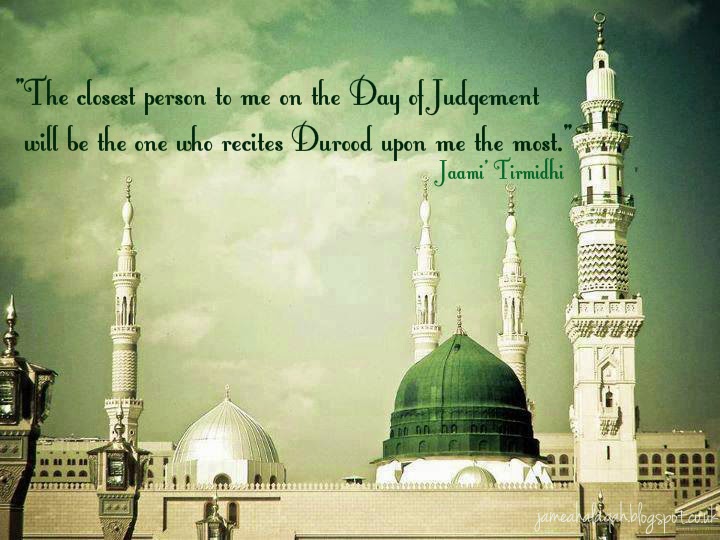
The Importance of Durood

Through the medium of the Quraan, Allah SWT has instructed us to carry out various acts of worship, for example, Establish Salaat, Pay Zakaat or to fast in the month of Ramadhan.
Even though Allah SWT has commanded us to do these, never has it been mentioned that He prays or that He fasts or that He gives Zakaat.
However there is one commandment that is unique, one in which Allah SWT Himself affirms His own participation: 

33:56


Indeed Allah and His Angels send blessings onto the Messenger SAW.

Oh you who believe, confer your blessings also and (ask Allah to) grant Him peace.
(33:56)

The fact that Allah Himself participates in the act of sending Durood upon the Messenger SAW highlights the importance of this act.

There are many Ahadith which mention the Prophet SAW’s request to send Blessings upon Him and how we should confer Salaat which will Allah willing, be mentioned below.

 In Imam Bukhari RH’s Tafseer of the abovementioned Ayah, he records that Ka’ab bin Ujrah RA said, “It was asked of the Messenger SAW of how Salaah should be sent upon Him as the Sahaabah RA knew the method of sending Salaam.” Prophet SAW replied,
“Say, Oh Allah SWT, send your Salaah upon Muhammad SAW and upon the family of Muhammad SAW, as You send Your Salaah upon the family of Ibrahim AS, verily You are the Most Praiseworthy, Most Glorious.
Oh Allah SWT send your Blessings upon Muhammad SAW and upon the family of Muhammad SAW, as You send Your Blessings upon the family of Ibrahim AS, verily You are the Most Praiseworthy, Most Glorious.”

In another Hadith, this has been explained in further detail;
When this Ayah was revealed, the Sahaabah RA said, “Oh Messenger SAW, we now come to know of the manner of reciting Salaam upon You as we recite in Tahiyyaat:
            السلام عليك أيها النبي و رحمت الله و بركاته

‘Peace be upon You, Oh Messenger SAW and the Mercy of Allah and His Blessings.’
“Please show us how to recite Salaah upon You.”
The Prophet SAW then recited Durood Ibrahim AS.

It has been mentioned by Abul ‘Aliyah RA in a narration that “Salaah refers to praise of the Prophet SAW in front of the Angels by Allah SWT and the Salaat of the Angels is their supplication for Him.” [Bukhari]

Imam Tirmidhi RH said, “This (the above) has been narrated from Sufyaan Thawri RH and other scholars who have said, “The Salaah of the Lord is Mercy and the Salaah of the Angels is their seeking forgiveness.””

In another narration it has been mentioned that “Salaah is the honouring of the Messenger SAW with kindness and affection by Allah SWT.” [Fadhail Salaat ala Nabi SWT – Sh.Zakarriyah RH]

Hadhrat Ibn Abaas RA in his Tafseer (commentary) of the above Ayah states that “Salaah means to pray for blessings.” The Angels sending Dua can also be referred to as “their Dua in favour of the Prophet SAW for a higher rank.” [Ruh ul Bayaan]

It has also been mentioned in Ruh ul Bayaan that one interpretation of Salaah is “Following in His SAW’s footsteps and expressing love for Him”.

‘Allamah Sakhaawi RH has narrared on the authority of Amr bin Rabi’ RH that the Messenger of Allah SAW said, “Whosoever confers Salaah upon me once, Allah SWT confers ten mercies upon him. It is at your discretion to confer as little or as much as you wish.” [Fadhail Salaat ala Nabi SWT – Sh.Zakarriyah RH]

This concludes a basic outline of this great and unique instruction of the Quraan, to send Salawaat and Durood upon our Beloved Messenger SAW.
The above can be summarised through the understanding of the following:
-         The Ayah is a unique commandment due to the fact that Allah SWT Himself participates in Durood
-         The Angels participate in this virtuous act
-         The Believers have been honoured with the ability to join Allah and the Angels to confer their own Durood
-         For one Durood recited, the recite gets ten mercies conferred upon him by Allah SWT

Friday, 27 March 2015

IMAM GHAZALI ON HUMILITY

Your belief that you are better than others is sheer ignorance. Rather you ought not to look at anyone without considering that he is better than you and superior to you.


Thus, if you see a child, you say, ‘This person has never sinned against God, but I have sinned, and so he is better than I.’
And if you see an older person, you say, ‘This man was a servant of God before me, and is certainly better than I.’
If he is a scholar, you say, ‘This man has been given what I have not been given and reached what I did not reach, and knows what I am ignorant of; then how shall I be like him?’
And if he is ignorant, you say, ‘This man has sinned against God in ignorance, and I have sinned against Him knowingly, so God’s case against me is stronger, and I do not know what end He will give to me and what end to him.’
If he is an infidel, you say, ‘I do not know; perhaps he will become a Muslim and his life will end in doing good, and because of his acceptance of Islam something of his sins will be taken away, as a hair is taken from dough; but as for me – God is our refuge (God grant it does not happen) – perhaps God will lead me astray so that I become an infidel and my life ends in doing evil, and then tomorrow he will be among those brought near to God and I shall be among the punished.’
Arrogance will not leave your heart except when you know that the great man is he who is great in the sight of God Most High. That is something which cannot be known until the end of life, and there is doubt about that (the end and whether it will be good or bad).
So let fear of the end occupy you and keep you from making yourself out, despite the doubt about your end, to be above the servants of God Most High. Your certitude and faith at present do not exclude the possibility of your changing in the future; for God is the Disposer of hearts; He guides whom He will and leads astray whom He will.
Extract from Imam Ghazali’s Bidayat al-Hidaya or ‘The Beginning of Guidance’
Credit goes to original poster: https://faithrehearsed.wordpress.com/2014/08/14/imam-ghazali-on-humility/

Saturday, 28 February 2015

99 Names of Allah

Prophet Muhammad (peace be upon him) said: 
'To God belongs 99 names, 100 minus 1, anyone who memorises them will enter Paradise; He (God) is odd (odd number, he is the Only One), and He loves odd numbers (such as 99)' [Sahih Muslim]
The first man Adam (AS) was taught the names of everything. 
"Teaching names means making man conscious of the essence of these things. This consciousnes implies full knowledge. Full knowledge is impossible without the essence becoming part and parcle of the being. 
By studying the manes of Allah, a person with (insha'Allah) understand Allah and the essence of things.

ALLAH - This is the greatest name and it is the sign of the cause of all existence. Allah is only Allah’s name and no one can share it. Whoever reads الله 1,000 times daily, all doubt will be removed from his heart and determination and faith will replace it all.
These 99 names are those names by which Muslims regard as Allah. The Quran and hadeeth have mentioned these names. There is one narration by Abdullah ibn Mas’ud in which he states that some names have been hidden from mankind. [Taymiyyah]. This shows that other than the 99 names, there may be other names of Allah.
According to Islamic tradition, a Muslim may not be given any of the 99 names of God in exactly the same form. For example, nobody may be named al-Malik (The King), but may be named Malik (King). This is because of the belief that God is almighty, and no human being is the equivalent of God, and no human being will ever be the equivalent of God. Muslims are allowed to use the 99 names of God for themselves but should not put 'Al' at the front of them.
However the names of God can be combined with the word "‘Abd-" which means "servant/Worshiper" (of God) and are commonly used as personal names among Muslims. For example ‘Abd ar-Raḥmān ("Servant of the Most Compassionate/the Beneficent").

Tips on how to memorise Asmaa’ ul Husnaa

Always have the correct intention and don’t think this as a burden!
Repeat the names you learn continuously everywhere (except when in the toilet)
Go home and make your family members memorise the names you learnt
Challenge your friends by testing them at random times!
Allah accept our efforts and make memorising his names easy for all of us. Ameen.
Ar-Rahmaan (The Compassionate) - Only he is the one who can provide mercy and good for his creations. If this name is recited 100 times daily after each Salaah, hard-heartedness and negligence will be removed from your heart. Insha’ Allah
Al – Gafoor (The Forgiver and Hider of faults) – He who has a headache, fever and despondent, and continuously repeats this name will be relieved of his ailment and will have Allah’s forgiveness.
Al – Hafeez (The Preserver) - He who repeats this name frequently and keeps it with him will be protected against calamities.

Al – Khaaliq (The Creator) – Whomsoever repeats this name 100 times for seven days without break, Allah will create an angel whose duty will be to act righteously for this person until the day of Judgement.

"What Is Happiness?"


Sunday, 15 February 2015

Hafsa (RA) Mother of the Faithful

In the name of Allah, the Most Gracious, Most Merciful.

She is the daughter of 'Umar ibn al-Khatab RA. In Arabic language, Hafs is one of the names of the lion. The Messenger of Allah SAW, would often address Umar RA as Abu Hafs.
There is a story for behind her entering the household of Prophethood as a wife of the Messenger of Allah (SAW).
She was married to a man known as Hisn ibn Hudafah who witnessed the Battle of Badr and then fell ill at Madeenah and passed away. Hafsa (RA) then became a widow. It had been part of Arab culture, either in the age of ignorance or after the emergence of Islam, that a man makes efforts to marry off his daughter, sister or any woman in his guardianship without any inconvenience - to someone he believed was good and suitable. This is because; her continuous stay in his house as an unmarried girl or a widow was regarded a great shame.
So when Hafsa (RA) became a widow, it pained Umar and he was distressed. He went out one day heading for the house of the nearest person to him who was Abu Bakr as Siddeeq RA. He informed him of what is in his mind and offered him Hafsa RA in marriage. Abu Bakr kept silent and did not utter a word. Umar left his house greatly distressed and embittered.

Then Uthman RA came to his mind. Since his wife, Ruqayyah, the Prophet's daughter had passed away; he was in a better position to respond favourably to his offer. So he made for his house, Mother of the Faithful for his house and offered him his daughter in marriage. But Uthman RA told him, "I do not want to marry today."
Who was she that can replace Ruqayyah in Uthman's house after both of them have enjoyed the life with each other for many years? And 'Uthman was in a psychological state that could not allow him to propose marriage or to marry. Umar RA’s distress increased.

The Messenger of Allah SAW then saw him in that condition. He SAW asked him about what ws troubling him and Umar RA told him of his encounter with Abu Bakr and Uthman. Bitterness and rage against them could be noticed in his speech and the way he talked. The Messenger of Allah SAW calmed him down and then said, "Hafsa RA shall marry someone who is better than Uthman RA and Uthman RA shall marry someone who is better than Hafsa RA."

Umar stood up, somewhat calmed, but he was still scratching his head over the meaning of the Prophet's statement. When Abu Bakr RA met him, he approached him and they talked with each other. Umar RA informed him of what he heard from the Messenger of Allah SAW and he told Abu Bakr that he could not understand the statement.

Abu Bakr smiled and said, "I have heard the Messenger of Allah SAW mentioning Hafsa. But I would not like to reveal his secret. If he had not shown his interest in marrying her I would have married her. So do not bear any grudge against me."
Uthman came to the Messenger of Allah SAW in his softness, bashfulness and sorrow. He was tearful and gloomy. He said, "My marriage relationship with you has come to an end with the death of Ruqayyah, Oh Messenger of Allah!"
The noble Messenger SAW sympathised with him and then said, "I have given you her sister, Umm Kulthoom, in marriage. If I had had ten daughters, I would have given them to you in marriage (one after the other)."

That is how the Messenger of Allah SAW married Hafsa RA and Uthman married Umm Kulthoom. And that is how Hafsa enter the household of the Prophet SAWas one of the mothers of the faithful.
Hafsa RA was a devoted worshipper, very pious, always fasting and praying in the night. She was the closest to 'A'ishah among the Prophet's wife. It is as if they were two sisters. They were always in agreement and never disagreed.
However, Hafsa had in her nature an aspect of the meaning of her name: She was somewhat stern and tough. Perhaps, she inherited that from her father 'Umar, al-Farooq. This sternness was increased by the death of her first husband, making her easily irritated.
It was this nature of hers that caused the Messenger of Allah (SAW) to divorce her once after which he took her back.

Ibn Sa'd recorded that the Messenger of Allah SAW divorced Hafsa once and then took her back because the Angel Gabriel told him, "Take Hafsa back, for she frequently fasts and prays in the night. And she is your wife in Paradise."
Humayd ibn Anas narrated that, "The Prophet SAW divorced Hafsa and he was thereafter commanded to take her back, and he did so."
'Uqbah ibn 'Amir narrated that the Messenger of Allah divorced Hafsa, 'Umar's daughter. When 'Umar heard this, he strewed sand over his head and said, "Allah will no more care about Umar and his daughter after she has been divorced [by the Prophet (SAW)]." So Angel Gabriel came to the Messenger of Allah the following day and told him, "Allah commands you to take back Hafsa as a way of showing compassion to Umar (her father)."

Abu Salih in his version of the narration said, “Umar entered the place of Hafsah while she was crying and he asked her whether the Messenger of Allah SAW has divorced her. He said to her, 'He had divorced you once and took you back only because of me. If he divorces you again, I will never speak: to you again.'  After that, Hafsa was keen never to annoy the Prophet (SAW) again until he died.

Here, dear reader, we need to point to a new and illuminating aspect of Hafsa’s personality in addition to her other values and qualities.
Angel Gabriel described her for the Prophet SAW that she was frequently performing (voluntary) fasting and night prayers, and that she is one of his wives in Paradise. These are degrees and ranks, as well as practical attributes and spiritual activities.
Another quality you can add to her credit is the fact that she could read and write, a quality that was very rare among womenfolk then, even among men. The new thing that attracts our attention here is that her house was the place in which the revealed verses of Qur'an written on palm branches, slates and other materials were kept.
She was entrusted with the most honourable and the greatest thing. And she deserved that.

This was the case since the time of the Messenger of Allah SAW up to the time of Uthman. When Uthman was compiling the Qur'an and copying it in a single book form, those kept with Hafsa was the primary sources in doing so.
This role played by Hafsa, transcended her life in the house of the Prophet, unto Islam itself. It was full of religiosity, activities, orderliness and a course of action.
We cannot but make a stop, as a means of honouring the mother of the faithful, Hafsa. For, she was the custodian of the Book of Allah. She preserved it in her heart and in her house.
Whenever we open a copy of the Quran to read it, we have to remember the Angel entrusted with the Revelation (Gabriel) and his reverberating sound, the impact the verses had on the heart of the Messenger of Allah SAW and the scribes of the Revelations: 'Ali, Zayd and others. We have to remember Abu Bakr and 'Umar and their compilations of the Qur'an; and Uthman and his resoluteness, trustworthiness and sense of duty; and finally Hafsa and her preservation of the Book.

We have to remember and seek guidance from Allah, the Great in His Majesty.
At the beginning of the year 44 A.H., Hafsa departed from this world and joined the company of the loved ones, Muhammad (SAW) and his Companions.


TAKEN FROM WOMEN AROUND THE MESSENGER (SAW)