Saturday, 9 May 2015

Khalid bin Waleed RA

Name- Khalid bin Walid al Mugheerah RA
Father- Al Walid (Chief of the Bani Makhzum - one of the noblest clans of the Quraish)
Mother- Lubaba al-Sughra bint Al-Harith
Siblings- 5 brothers and 2 sisters
Birth- Makkah - 592
Death- Emesa (modern day Homs, Syria) - 642

Khalid bin Walid RA was a courageous Sahabah amidst the Muslims and his skills and abilities allowed him to accomplish many great things. His faith, prime values, firm foundations and commitment to Islam enabled him to fulfil many rights and it has been said 'no man sacrificed more than Khalid bin Walid RA for what they believed in.'

Family
Khalid bin Waleed RA came from one of the noblest tribes of the Quraish, Bani Makhzum. His father Walid bin Mugheerah was the leader of the clan and was well known around Arabia. His father was  the biggest enemy of Islam even though Allah SWT had bestowed him with so much wealth, beauty, and leadership that he was known as Rayhaan al Quraish (flower of the Quraish) and Waheed al Qaum (The Unique), however, he was deprived of the greatest of all bounties; Islam. No man was more intelligent than him and it was he who coined the term ‘Liar’ for the Prophet SAW. This was when the Quraish gathered and discussed how to stop the Prophet SAW from preaching monotheism. They offered a few suggestions; poet, magician etc but all of these were refuted and hence came forth the accusation of liar. (Na’oozu Billah)
The hate for Islam that Waleed bin Mugheerah had for Islam can be demonstrarted in the fact that he even offered his own son Ammarah to Abu Talib in return for the Prophet SAW. Abu Talib was shocked by this offer and he replied, “You give me your son to feed and bring up while you want mine so you can kill him. By Allah, this shall not be.”
Khalid bin Waleed RA had 5 brothers and 2 sisters, his brother Waleed, after being captured at the Battle of Badr, became a Muslim.

Childhood
Khalid RA whilst still a child was taught how to ride. It was a mark of the Bani Makhzum tribe to be a perfect rider and he soon acquired mastery over the art of horsemanship. He also learnt the skills of combat and with it the various other weapons such as the spear, lance, bow, and sword. He also learnt to fight on horseback and on foot. While he became skilful in the use of all weapons, the ones for which he appeared to have had a natural gift was the sword for mounted and dismounted dueling. He was so talented that it has been reported that he could ride with a sword in each hand and use his feet to control his horse.

Adulthood
Khalid RA grew into a man and attained a great height at above 6 ft. His shoulders widened his chest expanded and the muscles lean on his body. His beard appeared full and thick on his face too. With this fine physique and forceful personality and tactical skills he soon became known as a popular and much admired figure in Makkah. He had married and had children and was occasionally known as Abu Sulaiman.

Battles

Battle of Uhud
When Uhud commenced the man who was responsible for defeat of the Muslims was Khalid bin Waleed. The Prophet SAW commanded 50 Sahabah to stand at the mountain of Uhud and instructed that under no circumcisions should they descend from their position even if they were to see birds pecking on our heads. This was because the mountain was a passage onto the battlefield and a strategic position occupied by the Muslims.  On three occasions Khalid tried to attack but the archers repelled. Slowly the Muslim began to gain the upper hand and many Quraish fled the battlefield. The Muslim archers then fell into dispute as to if they should leave. 40 decided to leave and it was then that Khalid got his opportunity.
Amr Ibn Aas RA described Khalid as ‘A friend of death, a master of warfare as well as having the dash of a lion and patience of a cat.’
On that day he showed the patience of a cat as he waited for the perfect opportunity and then attacked the 10 Sahabah from the back and like the dash of a lion he had got the upper hand.

Battle of Khandaq
The time for another battle had come upon the Muslims, this time it was the Battle of Khandaq (trenches), so called because trenches were dug around Madinah to prevent the enemy entering the city. Khalid’s duty once again was to kill the Prophet SAW. Khalid had orchestrated the movement of the Mushrik cavalry so well that the Muslims had no rest. Only two people were able to cross the trench and one was Khalid. He unrelentingly attacked the Muslims and it took 200 Sahabah to fight him off. Because of Khalid bin Walid Allah revealed the Salat al Khauf where the Sahabah were permitted to pray Salaat on the battlefield due to the relentless attack of the enemy.

Entering Islam
A year later, the Prophet SAW came to Hudaibiya. Once entering the first person He SAW asked for was Khalid RA.  Khalid’s brother replied that ‘Khalid has left Makkah saying that if Khalid is in Makkah and Muhammad is in Makkah then Muhammad would not return alive.
To this the Prophet SAW replied, “Has an intelligent man like Khalid not understood that there is only One Allah and that I am His Messenger SAW?”
Waleed RA thereafter wrote to Khalid and informed him about his conversation with the Messenger SAW. These words despite being conveyed in letter form permeated the words of Khalid RA so deeply that what was the most hated thing to him suddenly became the most beloved.
This is a living example of the Prophet SAW’s words,
“The heart of a believer is in the hands of Allah.”

That very night, accompanied by Uthman bin Talha and Amr ibn al Aas,  Khalid took his armour, weapons and horse and set out for Madinah. The three seekers entered Madinah and after being warmly welcomed by the Messenger SAW, accepted Islam. Khalid RA at the age of 43, the prime of his life, took the Shahaadah and became a noble companion of the Prophet SAW. He would often visit the Messenger SAW and listen intently for hours to His words of wisdom and virtue.

After Islam
After entering Islam, Khalid RA used his tactics and military experience to assist the Muslim armies. He took part in the battle of Mutah and after the three Ameers had been martyred, became the commander and by using his intelligence to confuse the Romans, lead the Muslims to victory.
The Prophet SAW upon hearing of the martyrdom of the three Sahaabahs made Dua for their entry into Jannat and mentioned that now that Khalid RA was the commander, the sword of Allah had been unsheathed. This was the battle in which Khalid was bestowed with his title ‘Saifullah’ – The sword of Allah. It had only been three months since Khalid RA had accepted Islam and in this period he had gone from a staunch enemy of Islam to the ‘Sword of Allah’!
Once Khalid RA became injured, the Prophet SAW took his saliva and applied it onto the wound and it at once healed.
During the Fatah (Conquest) of Makkah, it was the duty of Khalid RA to destroy the idols.

After the demise of the Prophet SAW
After the death of Muhammad SAW, many powerful Arab tribes broke away in open revolt against the rule of Medina.  Abu Bakr RA sent his armies to counter the rebels and apostates. Khalid was one of Abu Bakr RA’s main advisors and an architect of the strategic planning in many wars, especially the Battle of Rida. Khalid RA took part in the battle of Yarmouk and in that battle the Byzantine States became opened up for the Ummah due to Allan's mercy. He was the military commander who lead the victories for Muslims. After this Damascus, Syria, Palestine and Jordan all became part of the Muslim States under Khalid bin Walid RA. Yarmouk was almost like a culmination and almost seems as though for the past 23 years or so Allah was preparing him for Yarmouk slowly but surely. After Hadhrat Umar RA became the Khalifah, Khalid RA was replaced by Abu Ubaidah RA as the chief of the army.

Death
In the last four years of his life, Khalid RA due to his numerous injuries could not go into the battlefield. He dubbed that year ‘The year of the Women’ due to his inability to fight. However despite this, Khalid RA did not waste any time; he would recite Quran from after Fajr until Zohr, then after praying Salaat continue reciting until Asar and so forth. He would cry continuously out of the fear of Allah.
When he was on his deathbed, a friend came to visit him, Khalid RA lifted the sheet which was covering his body and said, “I have fought so many battles but look at me, I am here dying on my bed.” His friend replied, “Don’t you understand that the day the Prophet SAW honoured you with the title of ‘the Sword of Allah’ it was impossible for you to die in the battlefield, for if you were to die on the battlefield it would mean that the Sword of Allah could be broken by an infidel and this could never be!”
His friend also reports that ‘Not a single hand span of his body was left without scars or wounds’.
The only possessions left by Khalid RA were his sword and horse which he bequeathed for Umar RA. When Umar RA saw these he began to cry saying, “No man would be able to fulfil the rights of thw sword and horse like the way Khalid RA did.”

Sunday, 3 May 2015

Voting

Three Electoral Commitments
Every Muslim Should Make

By Shaykh Mawlānā Muhammad Saleem Dhorat hafizahullāh
Like the rest of the country, the UK’s Muslim community is gearing up to vote on May 22nd. The political parties have been campaigning in earnest for some time, outlining their policies and stressing their commitments to the nation. During the days preceding polling day, Britain’s Muslims should be asking themselves what commitments they have made when it comes to casting their votes.

Here follows a summary of a speech delivered by Shaykh Mawlānā Muhammad Saleem Dhorat hafizahullāh, containing valuable advice for the Muslim voter.

The Secret of Success

Allāh ta‘ālā has placed the desire for progress, and the spirit of mutual competitiveness that accompanies it, into the very nature of man. It is natural for individuals and communities to strive to better themselves and achieve progress. As Muslims, we should open the pages of history and discover and adopt those factors which make a nation prosperous, as long as they fall within the bounds of the Sharī‘ah, so that we too can reap the Dīnī and worldly benefits of progress.

Our study should commence with trying to ascertain the secret behind the success of the noble Sahābah radhiyallāhu ‘anhum, for they are ideal role models of a community that attracted success in its every endeavour. A thoughtful investigation will reveal three prominent qualities which can be attributed to their success. In this election season, every Muslim, no matter what his/her preferred party, should commit him/herself to observing these three principles in order to secure success and achievement, both on a personal and a communal level.

The First Commitment - Taqwā

The Sahābah radhiyallāhu ‘anhum hated all disobedience to Allāh ta‘ālā, they neither had a habit of sinning nor were they fond of any sins. Abstention from sins is the essence of taqwā, and through it Allāh ta‘ālā has promised relief from every difficulty.

In dealing with the election issue, we must not say or do anything that displeases Allāhta‘ālā. Of all the sins to beware of, backbiting and slander are major sins which are a particular threat at such times. One inclined towards a particular party should not backbite or slander a supporter of another party, for in doing so the requirements of taqwā will be compromised; and Divine assistance and blessings can not be expected in the absence of taqwā.

The Second Commitment - Ikhlās

Every decision taken by the Sahābah radhiyallāhu ‘anhum was for the Pleasure of Allāhta‘ālā, keeping in mind the life hereafter and the good of the community. They would be ready to sacrifice everything for the sake of Allāh ta‘ālā. Whether standing for election, supporting a party or voting, a Muslim must be pure in his intentions. This intention should be to elect the candidate who will best serve the Muslim community in common and humanity in general. If a Muslim has sincerity then his vote will go to the right candidate, for he will consider that he is voting to please Allāh ta‘ālā and therefore he will expend his energies in finding out who the best candidate is.

The Third Commitment - Unity

Unity is a key factor for the success of any nation; a truly united community can withstand any competition. Individuals should have the courtesy of mutual respect despite their political rivalries. Sadly, the Muslim community is a divided one. Every individual has the right to his own opinion and his own preference, within Shar‘ī boundaries, but our mutual differences transform into malice and enmity towards each other. Not even our masājid are free from our feuding. We can only hang our heads in shame when matters reach ahead and TV and press reports announce that political wrangling amongst Muslims has spilled over into fights outside a masjid after Friday prayers.

We go to the extremes; if we like something in a particular person, we praise him to the extreme, whereas if we disagree with someone on one issue, we become blind to all the good qualities he possesses. Our dealings are but a faint shadow of the Islāmic concept of brotherhood our beloved Prophet sallallāhu ‘alayhi wasallam taught. True brotherhood demands that whatever our political stripe, we should be able to sit at a table and sacrifice our political allegiances for the sake of Allāh ta‘ālā and agree to support the candidate who is best for the Muslims in common and the country in general. We should be willing to marginalize our differences in order to progress in a common direction.

In fact, if the Muslims of a particular constituency were to unite on a single platform and form a committee, responsible for recommending the best candidate to Muslim voters, every party would turn to the committee and seriously consider its demands on behalf of the Muslim community. They would realise the importance of securing the Muslim vote. All that is needed to achieve unity is a little sacrifice and the willingness to swallow one’s pride. May Allāh ta‘ālā grant us all the longing to strive for taqwā, ikhlās and unity. Āmīn.

Using Your Vote
  1. The vote is very important. It is a means of electing the person most beneficial for the community and our country.
  2. Voting is a big responsibility. Not voting or voting incorrectly will bring power to the wrong person.
  3. The best candidate deserves our vote.
  4. We should become politically aware.
  5. We should read every party’s manifesto.
  6. We should study party policies via the internet, radio, newspapers and knowledgeable people in our communities, who possess political acumen.
  7. We should find out which party offers us the best in all spheres of life; education, housing, health, social issues, international policy etc. Deciding on a party by just looking at one issue does not constitute farsightedness.
  8. We should think rationally, not make judgements based on emotions.
  9. Finally, we should make du‘aa to Allāh ta‘ālā, asking Him to enable us to make the right choice and that may He grant success to those who will serve the country and its citizens without any prejudice or wrong

Sunday, 12 April 2015

Basics of Belief


Course Description:

Three basic beliefs will be discussed in this course: Belief in Allah, Belief in Prophethood of our Beloved Messenger s.a.w, and Freewill and Predestination. The concept of Prophecy will be explored by reading and discussing some chapters from Qadhi Ayyaz’s book al-Shifa. 
 
The concept of destiny will also be explored. If Allah Ta’ala already knows everything and has written it down, how are we free to act? And if we are not free to act, why should we be punished for our sins?
 
Why should we even strive or make an effort when Allah Ta’ala has already written down our fates?
 
Why is there evil in the world?

To sign up please use the link below:
http://www.zaynabacademyonline.org/upcoming-courses/basics-of-belief/

Online Recordings are available for those who find timings inconvenient.

The FIQH of MENSTRUATION


Places can be reserved using the link below: 
https://www.eventbrite.co.uk/e/fiqh-of-mensuration-by-ustadha-umm-huzayfah-zamzam-academy-blackburn-25-april-2015-tickets-16430274393

Wednesday, 8 April 2015

CRISIS OF ISIS – PART 1 – WHAT MAKES A CALIPHATE?

When the Ottoman Empire disbanded in 1924 it marked a pivotal point in History. The Islamic Caliphate had come to an end, and the Islamic world was left without a single leader (Khalifah) to provide security, peace and the creation of a just society. Yet, the Muslim world was further divided by the Sykes-Picot border lines, created during the First World War. These borders did exactly what they were supposed to do – keep the Muslim world divided – and so they did.

The Caliphate is an embodiment of the Shari’ah in maintaining a just society. The Shari’ah contrary to how it is perceived by the West is a law of divine origin, which is cited by scholars as embodying ideas such as: freedom of religion, protection of life, protection of property, the right to an education, a just and fair legal system to name but a few. Just by this very understanding the Caliphate governing by the Shari’ah would establish what is known as the notion of utopia. Plato in his Republic attempted to pen down one of the earliest known ideas of utopia and this was followed centuries later by Thomas Moore who would go on to write an entire book called Utopia followed by Francis Bacon in his New Atlantis. The Caliph under the Shari’ah law would govern by God’s law in a just manner that wouldn’t allow for man’s desire to get the better of him. And so every wish of the Caliph would need to be agreed to by the Shari’ah.
One of the first Muslim scholars to pen down the doctrines surrounding the systematics encompassing the Caliphate system was al-Mawardi, al-Mawardi in his Ahkam Al-Sultaniya (The Ordinance of Government) argues that: “Men are naturally driven by desire to ignore the promises of the hereafter for the sake of immediate pleasure”, hence why al-Mawardi points towards the importance of having a ruler. Similarly Thomas Hobbes writes: “without rulers, men would exist in a state of utter chaos and unmitigated savagery”.
Imam al-Mawardi calls for certain qualities that must be present in a Caliph in order to qualify him as someone eligible for this position:
  1. Must have qualities of Adalah (Justice)
  2. Must have knowledge (‘ilm) and must be able to reason independently (Mujtahid)
  3. He must be physically fit and able (Kifaya)
  4. He must possess sound hearing, sight and speech
  5. Must be courageous and fearless (Najda)
  6. Must be from the tribe of Quraysh
These are the requirements for a potential Caliph as expounded by the illustrious scholars, yet in order for a potential Caliph to gain power and control there are a further four ways he can establish a Caliphate:
  1. Those mentioned directly or indirectly in the Qur’an and Sunnah.
    1. Abu Bakr al-Siddique
    2. Imam Mahdi
    3. Isa (Jesus)
  2. The Previous Caliph assigns another individual to lead.
    1. Example, Umar who inherited from Abu Bakr
  3. A group of influential people known as the Ahlul Halli Wal ‘Aqd must consult (shura) and give the pledge of allegiance (bay’ah) in order to put the caliph in power.
    1. The people of the Ahlul Halli Wal ‘Aqd must fulfil three criteria:
      1. Must be people of Adalah (They must be people who uphold justice)
      2. Must be knowledgeable of the criteria pertaining to the requirements of becoming a Caliph
  • They must be individuals who have a public voice
  1. Imam Ahmad in his Minhaj al-Sunna writes: “The Imam is the one whom all the Muslims are agreed on to call him the Imam”
  2. Abu Bakr was elected through a shura and then the bay’ah was given to him.
  3. Uthman ibn ‘Affaan became caliph after Umar delegated the decision to ashura of 6 senior sahabah
  4. Ali was elected the same way
The purpose of the Ahlul Halli wal ‘Aqd are to represent the majority of the Ummah, according to al-Ghazzali in his Mustazhiri even if this be a single person, however, note that al-Ghazali makes it quite clear that if it is a single person then this single person must represent the multitude of people. This view was also shared by al-Mawardi.
  1. The Caliphate can be taken by force (Ghalaba/Taghalub)
Based on these four criteria, the caliphate established by Abu Bakr al-Bagdhadi does not fit into criteria 1 as his name is not mentioned in the Kitab and Sunnah so that leaves three more. He doesn’t fit into the second category either as the Ottoman Empire was disbanded in 1924 so he never succeeded anyone. So it is either category three or four. It cannot be criteria 3 for the majority of the Muslims are against ISIS, the Ulama have responded in the negative.
Category three requires the Bay’ah of the ahlul Halli Wal ‘Aqd (Influential people), now these people are supposed to represent the majority of the Muslim ummah’s sentiment. However, Abu Bakr Bagdhadi’s Ahlul Halli Wal ‘Aqd are not reprehensive of the majority of the ummah and this is quite clear. In the UK alone senior Imams from both the Sunni and Shia sect united to create a 4 minute video denouncing ISIS as illegitimate. There was also a Fatawa response to ISIS by the great Mauritanian scholar Sheikh Abdullah Bin Bayyah denouncing the acts of ISIS as in great opposition to the true values of Islam. So, the rumoured people of influence that gave Bay’ah to al-Bagdhadi who are they?
The Bay’ah (pledge of allegiance) of the Ahlul Halli Wal ‘Aqd is required first before the creation not the other way round as was the case with ISIS. To claim that they represent Islam and are now the leaders of the Muslim Ummah and therefore requiring the Bayah Taa’ah (allegiance of obedience) as wajib on all of us is clearly fallacious. No such thing is required as the Bay’ah In’iqaad of their ahlul halli wal ‘aqd is considered invalid by the majority of the scholars who represent the majority of the people.
Therefore, based simply on this al-Bagdhadi’s state (dawla) is not one that is holistic in the sense of Dawla Islamiyya (Islamic State) which represents all the Muslims; but is merely a state based not on religious grounds but political. It has no claim to the concept of Caliphate as known by the Jurists. It is merely a political ploy perhaps in response to western foreign policy, or perhaps simply following orders by those above.
“When he is empowered, he sets out to do violence in the land, destroying crops and livestock. But God does not love violence” (Qur’an, 2:205).
Has not ISIS destroyed more than crops and livestock, even men, women and children? These very individuals many of which are young who are trigger hungry love the very thing Allah dislikes.
A statement of the Caliph ‘Umar ibn al-Khattab, may God be pleased with him, from his last sermon follows:
“Whoever pledges allegiance to someone not appointed by the consultative process of the believers, neither he nor the one to whom he pledged allegiance are to be followed, out of fear of foolishly exposing themselves to being killed with them.”
As for the last and final criteria well this still requires an oath of allegiance by the people, it is simply not the case that once power is taken that it is thereby evident the Caliphate is created and remains and no one can challenge it. Even within this there are certain requirements that needs to be filled.
From an Islamic point of view according to the Shari’ah the Caliphate that ISIS have established is effectively illegitimate. For which holder of truth and justice would ask young girls to join the caliphate and to leave their homes against their parents’ wishes?Source: https://faithrehearsed.wordpress.com/2015/04/05/crisis-of-isis-part-1-what-makes-a-caliphate/

Tuesday, 7 April 2015

Let go..

Let go of your worries
and be completely clear-hearted,
like the face of a mirror
that contains no images.
If you want a clear mirror,
behold yourself
and see the shameless truth,
which the mirror reflects.
If metal can be polished
to a mirror-like finish,
what polishing might the mirror
of the heart require?
Between the mirror and the heart
is this single difference:
the heart conceals secrets,
while the mirror does not.
– Divani Shamz Tabrizi

Sunday, 5 April 2015

He who seeks, FINDS..


A Spiritually Uplifting Seminar on
"He Who Seeks, Finds"
by Shaykh Mufti Kamaluddin Ahmed 
(Open to Men & Women both - FREE Seminar)

Allah Subhanahu wa Ta’ala says in the Qur’an (Surah al-Ankaboot: 69):
And those who strive for Us – We will surely guide them to Our ways. And indeed, Allah is with the doers of good.

Day: Monday, 6 April 2015
Time: 3:15 PM to 5:00 PM UK Time / 7:15 PM TO 9:00 PMPakistan time


LIVE Online Broadcast from Pakistan:
www.HajirahAcademy.org

Tuesday, 31 March 2015

Cleanliness

Allah SWT mentions in the Holy Quraan:
“Truly, Allah loves those repent to Him constantly and He loves those who purify themselves.” (2:222)

9:108
“Within it (the Masaajid) are men who love to purify themselves. And Allah SWT loves those who make themselves clean and pure.” (9:108)

The Messenger of Allah SAW has said, “Cleanliness is half of faith.” [Muslim]
He SAW also said, “Religion is founded on cleanliness.”

There are two categories of cleanliness; Physical and Spiritual.
Physical cleanliness can be understood from the act of performing Whudu or Ghusl before acts of worship such as Salaat or recitation of the Quraan.
Spiritual cleanliness means that a person strives to be free from the defects of the heart such as ill manners, pride, materialism and hypocrisy to name a few.
Physical cleanliness lays the foundation to achieving the ultimate goal of Islam; cleanliness of the Nafs (inner-self) and ridding oneself of diseases of the heart in order to attain the Pleasure of the Almighty SWT.
If we think of Zakaat (charity) and Sawm (fasting) we see that these by extension are more than mere pillars which need to be fulfilled, they are gateways to the purification of wealth and soul.
Physical cleanliness is of two types; one related to the human body and one related to the surroundings such as one’s home, the Madrassah and public places.
The importance of cleanliness in Islam can be gauged from the fact that Fiqh and Ahadith Kitaabs almost always begin with a chapter on cleanliness.
Personal hygiene:
A person should remember that failure to remain clean harms oneself and others around them. Women especially need to bear in mind the correct method of performing Whudu and Ghusl especially after Haidh (menstruation), intercourse and Nifaas (post childbirth bleeding). It has been mentioned that, “Even in this modern era where knowledge is so widely available, there are women who do not know how to perform Ghusl properly and it is only when they pass away and are given the Ghusl before being wrapped in Kafn (shroud) are they really clean.”
This statement should serve as a reality check for all of us.

Below are some tips on keeping clean and hygienic:
-         Bathe at least twice a week. NEVER let a week pass without bathing.
-         Change clothes regularly. “Keep your clothes clean.” (74:4)
-         Try and remain in the state of Whudu. By doing this, a person ensures that the parts regularly exposed to dust and dirt are kept clean.
-         Make sure that Istinjaa is done properly. Many may find this a trivial point but in the time of the Messenger SAW, a man was punished in his grave simply because he did not take care when urinating.
It was narrated that Ibn Abaas RA said:
The Messenger SAW passed by two graves and said, “They are being punished, but not for something difficult to avoid. One of them used to walk around spreading Nameemah (malicious gossip) and the other did not take care to avoid getting urine on himself.” [Muslim]
-         Cut nails weekly and remove any unwanted hair regularly.
-         Brush teeth twice a day and use a Miswaak throughout the day. The Prophet SAW said, “Had it not been difficult for my Ummah, I would have ordered them to use Miswaak before every Salaat.” [Bukhari]
It has also been mentioned in another Hadith: “Whoever eats from this foul smelling plant (raw onion) should not come near our Masaajid, because the Angels are troubled by what humans are troubled by.” [Bukhari, Muslim]
This by extension not only refers to foul breath but also body odours and smoke.
-         Comb hair daily. Once a man came to the Prophet SAW with his hair dishevelled and the Prophet SAW asked, “Has he no oil with which to tidy his hair?”
-         Cover mouth/nose when sneezing

The Prophet SAW advised the Muslims to appear clean and tidy in private and in public. Once when returning home from battle, He SAW advised his army, “You are soon going to meet your brothers, so tidy your saddles and clothes. Be distinguished in the eyes of the people.” [Abu Dawood]

Environmental hygiene:
Islam instructs Muslims to maintain the cleanliness of roads and streets. Ridding the streets of impurities and filth is considered to be an act of charity.
“Removing any harm from the road is charity (that will be rewarded by Allah).” [Bukhari]

The Prophet SAW said, “Beware of three acts that cause others to curse you; reliveing yourself in a place where there is stagnant water, on foot paths and in shaded places.” [Abu Dawood]
This also includes throwing litter in such places.

Even by removing a piece of rubbish the size of a matchstick you will a lot of reward as long as a person’s intention is correct. Especially whilst in Madrassah, we are guests of the Prophet SAW, think of how much reward such a small act can gain.

Hadhrat Abu Hurairah RA reported: A black woman used to clean the Masjid of the Messenger SAW. The Prophet SAW sensed her absence and asked about her, He SAW was told that she had passed away. He SAW then said, “Why did you not inform me?”
Then He SAW said, “Show me her grave.”
When it was shown to Him, He SAW offered Jazaazah (funeral) prayers over it and said, “These graves cover those in them with darkness, and Allah illuminates them for the inmates as a result of my supplication for them.” [Bukhari, Muslim]

This woman’s status was so high in the eyes of Allah, that the Prophet SAW prayed Janaazah Salaat over her grave. And to us, this woman would have been seemed like a nobody!

Even the Sahaabah RA used to clean up for others. When Hadhrat Abu Bakr RA was the Khalifah, he used to take time out every day to visit an old blind woman living on the outskirts of Madinah. He used to cook for her, clean her house and wash her clothes.

There is an incident regarding Maulana Hussain Ahmad Madni RH, he was once travelling on a train and there was a Brahman Hindu in the same compartment as his. The Brahman needed to use the toilet but returned quickly as the toilet was filthy. Maulana saw this and went himself and cleaned up the toilet. Upon returning, he informed the Brahman that the toilet was now fit for use but did not admit that it was he who cleaned the toilet. Such was his humility!
Such was the Akhlaaq (character) of our elders, compare this with our character!
Such acts are the best way to rid a person of pride and inculcate humility within a person.

In view of the significance of cleanliness in Islam, Muslims should have the highest standard of cleanliness and personal hygiene of all people, but it is highly regrettable that dirt has become the identity of Muslim homes and localities. The majority Muslim areas are marked with unhygienic conditions not to mention the highest incidence of rat infestation!

Let it not be that due to our laziness we incur the wrath of Allah SWT. 

Saturday, 28 March 2015

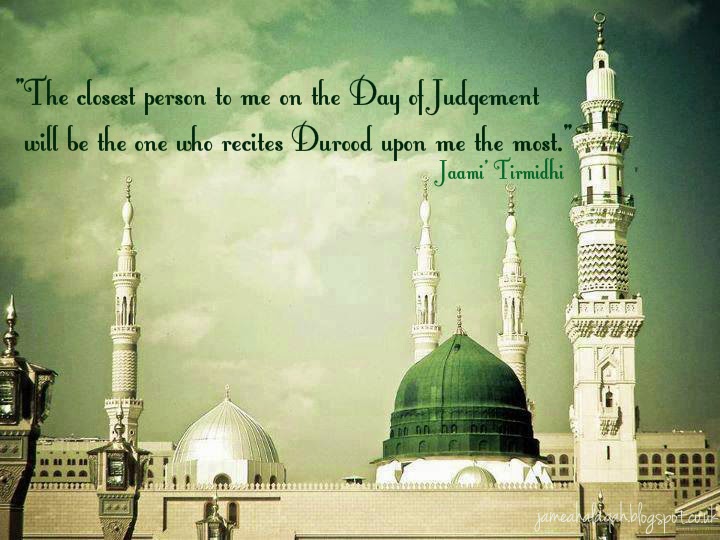
The Importance of Durood

Through the medium of the Quraan, Allah SWT has instructed us to carry out various acts of worship, for example, Establish Salaat, Pay Zakaat or to fast in the month of Ramadhan.
Even though Allah SWT has commanded us to do these, never has it been mentioned that He prays or that He fasts or that He gives Zakaat.
However there is one commandment that is unique, one in which Allah SWT Himself affirms His own participation: 

33:56


Indeed Allah and His Angels send blessings onto the Messenger SAW.

Oh you who believe, confer your blessings also and (ask Allah to) grant Him peace.
(33:56)

The fact that Allah Himself participates in the act of sending Durood upon the Messenger SAW highlights the importance of this act.

There are many Ahadith which mention the Prophet SAW’s request to send Blessings upon Him and how we should confer Salaat which will Allah willing, be mentioned below.

 In Imam Bukhari RH’s Tafseer of the abovementioned Ayah, he records that Ka’ab bin Ujrah RA said, “It was asked of the Messenger SAW of how Salaah should be sent upon Him as the Sahaabah RA knew the method of sending Salaam.” Prophet SAW replied,
“Say, Oh Allah SWT, send your Salaah upon Muhammad SAW and upon the family of Muhammad SAW, as You send Your Salaah upon the family of Ibrahim AS, verily You are the Most Praiseworthy, Most Glorious.
Oh Allah SWT send your Blessings upon Muhammad SAW and upon the family of Muhammad SAW, as You send Your Blessings upon the family of Ibrahim AS, verily You are the Most Praiseworthy, Most Glorious.”

In another Hadith, this has been explained in further detail;
When this Ayah was revealed, the Sahaabah RA said, “Oh Messenger SAW, we now come to know of the manner of reciting Salaam upon You as we recite in Tahiyyaat:
            السلام عليك أيها النبي و رحمت الله و بركاته

‘Peace be upon You, Oh Messenger SAW and the Mercy of Allah and His Blessings.’
“Please show us how to recite Salaah upon You.”
The Prophet SAW then recited Durood Ibrahim AS.

It has been mentioned by Abul ‘Aliyah RA in a narration that “Salaah refers to praise of the Prophet SAW in front of the Angels by Allah SWT and the Salaat of the Angels is their supplication for Him.” [Bukhari]

Imam Tirmidhi RH said, “This (the above) has been narrated from Sufyaan Thawri RH and other scholars who have said, “The Salaah of the Lord is Mercy and the Salaah of the Angels is their seeking forgiveness.””

In another narration it has been mentioned that “Salaah is the honouring of the Messenger SAW with kindness and affection by Allah SWT.” [Fadhail Salaat ala Nabi SWT – Sh.Zakarriyah RH]

Hadhrat Ibn Abaas RA in his Tafseer (commentary) of the above Ayah states that “Salaah means to pray for blessings.” The Angels sending Dua can also be referred to as “their Dua in favour of the Prophet SAW for a higher rank.” [Ruh ul Bayaan]

It has also been mentioned in Ruh ul Bayaan that one interpretation of Salaah is “Following in His SAW’s footsteps and expressing love for Him”.

‘Allamah Sakhaawi RH has narrared on the authority of Amr bin Rabi’ RH that the Messenger of Allah SAW said, “Whosoever confers Salaah upon me once, Allah SWT confers ten mercies upon him. It is at your discretion to confer as little or as much as you wish.” [Fadhail Salaat ala Nabi SWT – Sh.Zakarriyah RH]

This concludes a basic outline of this great and unique instruction of the Quraan, to send Salawaat and Durood upon our Beloved Messenger SAW.
The above can be summarised through the understanding of the following:
-         The Ayah is a unique commandment due to the fact that Allah SWT Himself participates in Durood
-         The Angels participate in this virtuous act
-         The Believers have been honoured with the ability to join Allah and the Angels to confer their own Durood
-         For one Durood recited, the recite gets ten mercies conferred upon him by Allah SWT

Friday, 27 March 2015

IMAM GHAZALI ON HUMILITY

Your belief that you are better than others is sheer ignorance. Rather you ought not to look at anyone without considering that he is better than you and superior to you.


Thus, if you see a child, you say, ‘This person has never sinned against God, but I have sinned, and so he is better than I.’
And if you see an older person, you say, ‘This man was a servant of God before me, and is certainly better than I.’
If he is a scholar, you say, ‘This man has been given what I have not been given and reached what I did not reach, and knows what I am ignorant of; then how shall I be like him?’
And if he is ignorant, you say, ‘This man has sinned against God in ignorance, and I have sinned against Him knowingly, so God’s case against me is stronger, and I do not know what end He will give to me and what end to him.’
If he is an infidel, you say, ‘I do not know; perhaps he will become a Muslim and his life will end in doing good, and because of his acceptance of Islam something of his sins will be taken away, as a hair is taken from dough; but as for me – God is our refuge (God grant it does not happen) – perhaps God will lead me astray so that I become an infidel and my life ends in doing evil, and then tomorrow he will be among those brought near to God and I shall be among the punished.’
Arrogance will not leave your heart except when you know that the great man is he who is great in the sight of God Most High. That is something which cannot be known until the end of life, and there is doubt about that (the end and whether it will be good or bad).
So let fear of the end occupy you and keep you from making yourself out, despite the doubt about your end, to be above the servants of God Most High. Your certitude and faith at present do not exclude the possibility of your changing in the future; for God is the Disposer of hearts; He guides whom He will and leads astray whom He will.
Extract from Imam Ghazali’s Bidayat al-Hidaya or ‘The Beginning of Guidance’
Credit goes to original poster: https://faithrehearsed.wordpress.com/2014/08/14/imam-ghazali-on-humility/